Maths Difficulties
Assessment of the cognitive processes involved in numbers and mathematics, and related attainment levels
A dyscalculia and maths difficulties assessment explores the underlying cognitive processes that affect how someone understands and works with numbers. It goes beyond simply testing arithmetic. It examines number sense, mathematical reasoning, and the specific patterns in how an individual approaches mathematical problems.
The result is a detailed picture of strengths and weaknesses, with tailored recommendations for support at school, at work, or at home.
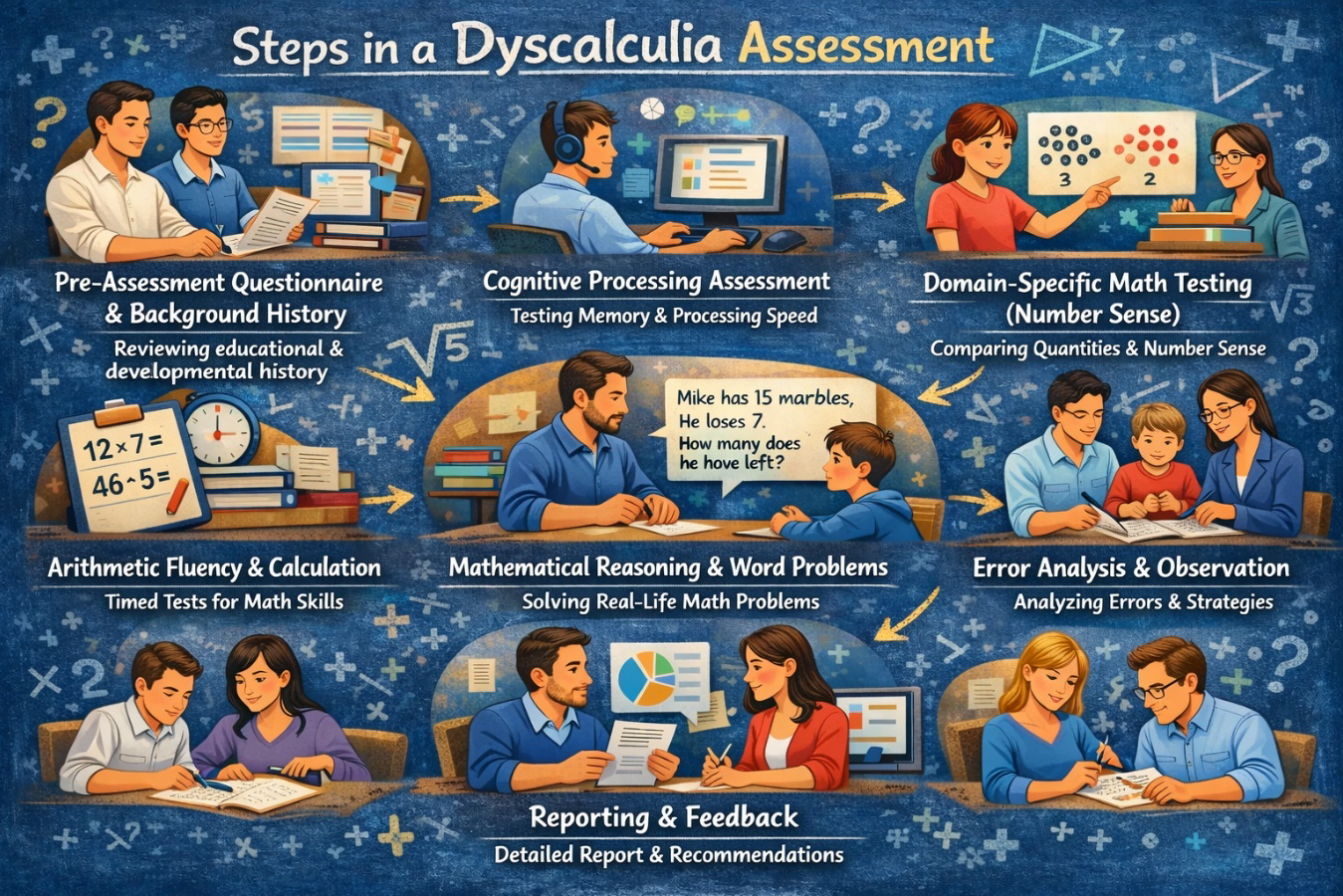
Steps in a Dyscalculia and Maths Difficulties Assessment
Pre-Assessment Questionnaire & Background History
Reviewing educational history, school reports, and questionnaires to understand developmental, medical, and learning background.
Cognitive Processing Assessment
Tests to measure working memory, processing speed, and visual-spatial reasoning.
Domain-Specific Math Testing (Number Sense)
Evaluates ability to compare magnitudes (which is larger?), subitising (instantly seeing “how many”), and understanding place value.
Arithmetic Fluency & Calculation
Standardised tests (timed and untimed) to measure speed and accuracy in addition, subtraction, multiplication and division.
Mathematical Reasoning & Word Problems
Assessing the ability to apply mathematical concepts to solve problems.
Error Analysis & Observation
Analysing how the individual solves problems and the specific mistakes they make, rather than just the final score.
Reporting & Feedback
A detailed report is generated outlining strengths, weaknesses, and tailored recommendations, followed by a feedback session.